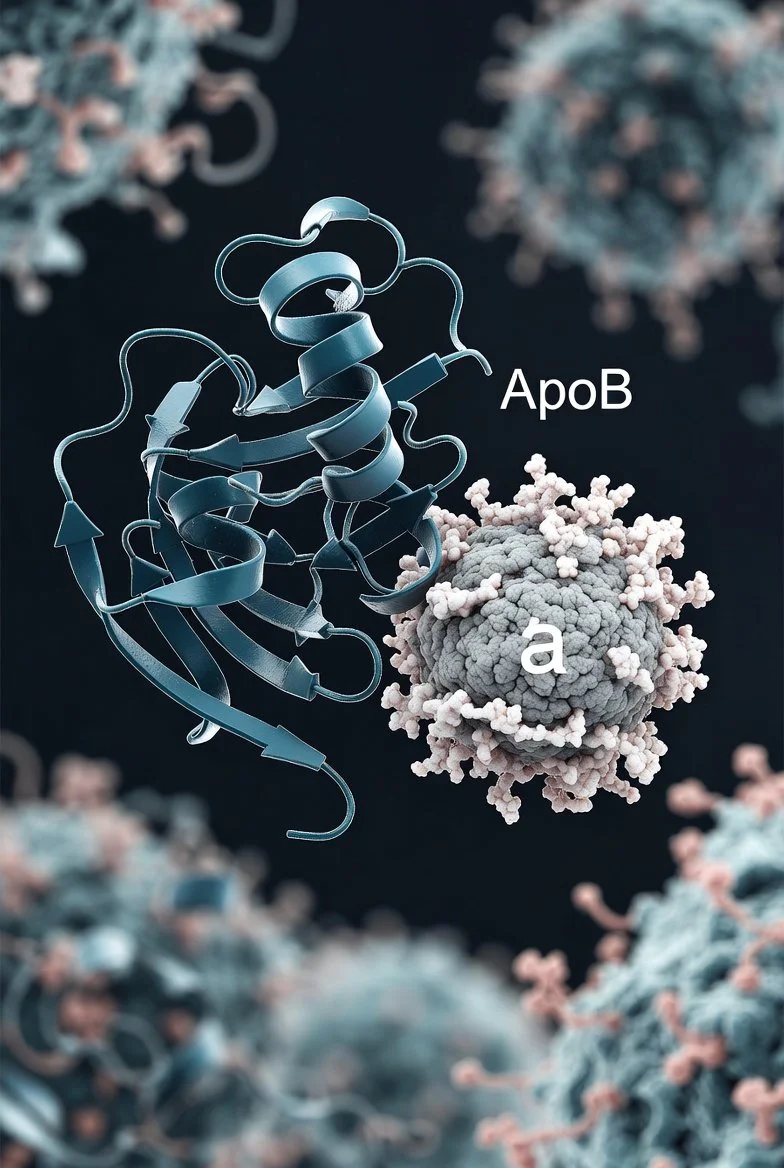
Why ApoB and Lipoprotein(a) Can Change the Entire Trajectory of Your Life

The Cholesterol Myth That Keeps People Sick

For decades, we were taught a simple story:

“If your LDL cholesterol is normal, your heart is safe.”

That story is wrong.

Every week, I see patients who:

  • Exercise regularly

  • Eat reasonably well

  • Have “acceptable” LDL cholesterol

…and still develop coronary plaque, heart attacks, or strokes.

The reason is simple: LDL cholesterol is not the same thing as LDL particles.

And particles are what damage arteries.

That’s where ApoB and Lipoprotein(a) come in.

The Cholesterol Myth That Keeps People Sick

For decades, we were taught a simple story:

“If your LDL cholesterol is normal, your heart is safe.”

That story is wrong.

Every week, I see patients who:

  • Exercise regularly

  • Eat reasonably well

  • Have “acceptable” LDL cholesterol

…and still develop coronary plaque, heart attacks, or strokes.

The reason is simple: LDL cholesterol is not the same thing as LDL particles.

And particles are what damage arteries.

That’s where ApoB and Lipoprotein(a) come in.

ApoB: The Particle Count That Actually Matters

Apolipoprotein B (ApoB) is a protein found on every atherogenic (artery-damaging) particle:

  • LDL

  • VLDL

  • IDL

  • Remnant particles

One particle = one ApoB molecule.
So ApoB tells us the true number of cholesterol-carrying particles circulating in your blood.

Why This Changes Everything

Two people can have the same LDL cholesterol:

  • Person A: Few large particles → lower risk

  • Person B: Many small particles → much higher risk

Standard cholesterol panels cannot reliably tell the difference.

ApoB can.

Torre Prime Longevity Insight

In Medicine 3.0, we care about lifetime arterial exposure, not whether today’s labs look “okay.”

Lower ApoB = fewer arterial injuries = more decades of healthy life.

Lipoprotein(a): The Genetic Risk Most Doctors Never Measure

Lipoprotein(a)—often written as Lp(a)—is a genetically inherited LDL-like particle with an added protein called apolipoprotein(a).

This extra protein makes Lp(a):

  • More inflammatory

  • More adhesive to artery walls

  • More resistant to breakdown

The Uncomfortable Truth

  • Your diet barely affects Lp(a)

  • Exercise barely affects Lp(a)

  • Many statins barely affect Lp(a)

You are largely born with it.

And if it’s high, your cardiovascular risk is significantly elevated, even with perfect lifestyle habits.

Many heart attacks in fit, lean, active people are explained by undiagnosed high Lp(a).

Why These Two Markers Are Life-Changing Together

ApoB tells us how many artery-damaging particles you have and determines cumulative vascular injury.

Lp(a) is a genetic “accelerant” of plaque and clotting and explains early or unexpected heart disease.

Together, they reveal:

  • Why plaque forms early

  • Why family history matters

  • Why “normal cholesterol” can still be dangerous

This is risk mapping, not guesswork.

What Torre Prime Does Differently

At Torre Prime, ApoB and Lp(a) are Sentinel-level markers—not optional add-ons.

We use them to:

  • Reframe cardiovascular risk decades earlier

  • Personalize lipid strategies beyond LDL

  • Decide how aggressive prevention should be

  • Integrate imaging (CAC, CTA) intelligently

  • Align lifestyle, medication, and training with your biology

This is not about fear.

It’s about clarity and control.

What Should Your Numbers Be?

General longevity-oriented targets (individualized per person):

  • ApoB:

    • Optimal: ~60 mg/dL or lower

    • High-risk individuals: often lower

  • Lipoprotein(a):

    • Ideally: as low as possible

    • Elevated risk often begins above ~75–100 nmol/L

These are not one-size-fits-all, and numbers only matter in context—your age, family history, imaging, and goals.

The Bigger Picture: Time Is the Real Risk Factor

Atherosclerosis is not sudden.

It’s:

  • Quiet

  • Slow

  • Cumulative

ApoB tells us how fast the damage accumulates.
Lp(a) tells us whether the process is accelerated.

When you know these early, you gain something priceless:

Time.

Time to intervene.
Time to course-correct.
Time to protect decades of strength, cognition, and independence.

The Torre Prime Philosophy

We don’t wait for symptoms.
We don’t chase emergencies.
We don’t accept “normal” when better is possible.

ApoB and Lipoprotein(a) aren’t just lab tests.

They’re maps of your future.

And maps are only powerful when you use them.

Read More