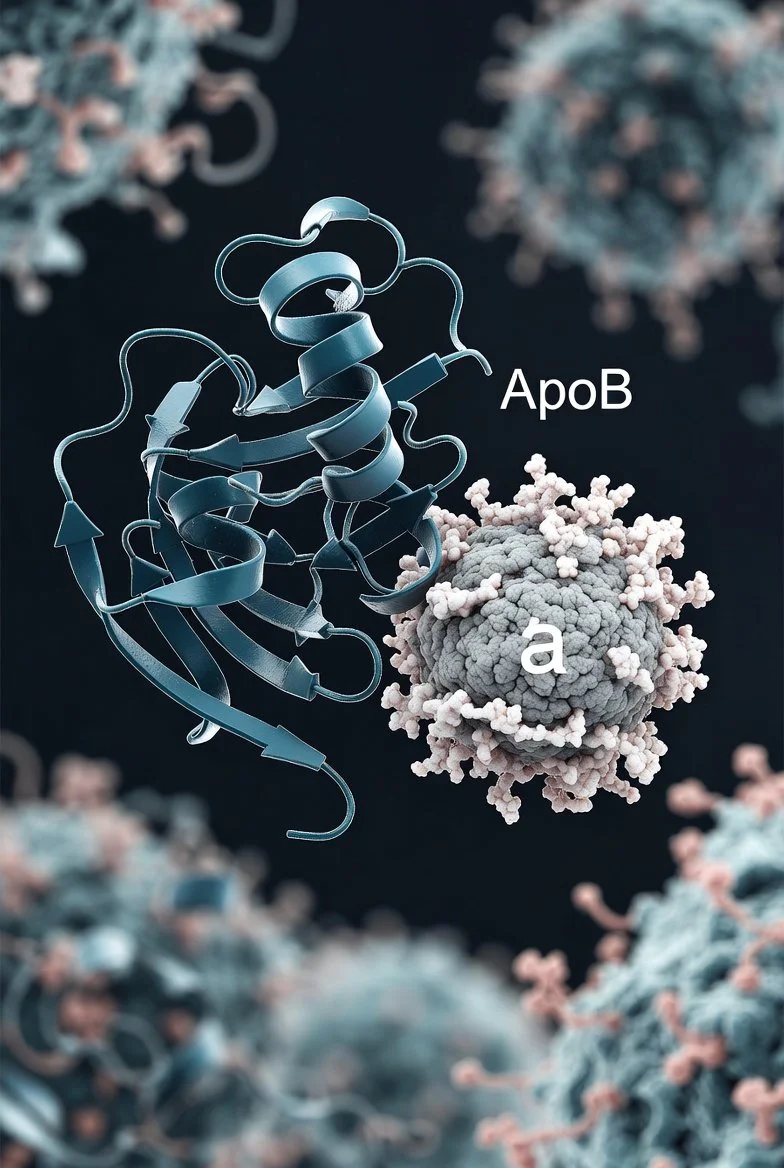
Why ApoB and Lipoprotein(a) Can Change the Entire Trajectory of Your Life

The Cholesterol Myth That Keeps People Sick

For decades, we were taught a simple story:

“If your LDL cholesterol is normal, your heart is safe.”

That story is wrong.

Every week, I see patients who:

  • Exercise regularly

  • Eat reasonably well

  • Have “acceptable” LDL cholesterol

…and still develop coronary plaque, heart attacks, or strokes.

The reason is simple: LDL cholesterol is not the same thing as LDL particles.

And particles are what damage arteries.

That’s where ApoB and Lipoprotein(a) come in.

The Cholesterol Myth That Keeps People Sick

For decades, we were taught a simple story:

“If your LDL cholesterol is normal, your heart is safe.”

That story is wrong.

Every week, I see patients who:

  • Exercise regularly

  • Eat reasonably well

  • Have “acceptable” LDL cholesterol

…and still develop coronary plaque, heart attacks, or strokes.

The reason is simple: LDL cholesterol is not the same thing as LDL particles.

And particles are what damage arteries.

That’s where ApoB and Lipoprotein(a) come in.

ApoB: The Particle Count That Actually Matters

Apolipoprotein B (ApoB) is a protein found on every atherogenic (artery-damaging) particle:

  • LDL

  • VLDL

  • IDL

  • Remnant particles

One particle = one ApoB molecule.
So ApoB tells us the true number of cholesterol-carrying particles circulating in your blood.

Why This Changes Everything

Two people can have the same LDL cholesterol:

  • Person A: Few large particles → lower risk

  • Person B: Many small particles → much higher risk

Standard cholesterol panels cannot reliably tell the difference.

ApoB can.

Torre Prime Longevity Insight

In Medicine 3.0, we care about lifetime arterial exposure, not whether today’s labs look “okay.”

Lower ApoB = fewer arterial injuries = more decades of healthy life.

Lipoprotein(a): The Genetic Risk Most Doctors Never Measure

Lipoprotein(a)—often written as Lp(a)—is a genetically inherited LDL-like particle with an added protein called apolipoprotein(a).

This extra protein makes Lp(a):

  • More inflammatory

  • More adhesive to artery walls

  • More resistant to breakdown

The Uncomfortable Truth

  • Your diet barely affects Lp(a)

  • Exercise barely affects Lp(a)

  • Many statins barely affect Lp(a)

You are largely born with it.

And if it’s high, your cardiovascular risk is significantly elevated, even with perfect lifestyle habits.

Many heart attacks in fit, lean, active people are explained by undiagnosed high Lp(a).

Why These Two Markers Are Life-Changing Together

ApoB tells us how many artery-damaging particles you have and determines cumulative vascular injury.

Lp(a) is a genetic “accelerant” of plaque and clotting and explains early or unexpected heart disease.

Together, they reveal:

  • Why plaque forms early

  • Why family history matters

  • Why “normal cholesterol” can still be dangerous

This is risk mapping, not guesswork.

What Torre Prime Does Differently

At Torre Prime, ApoB and Lp(a) are Sentinel-level markers—not optional add-ons.

We use them to:

  • Reframe cardiovascular risk decades earlier

  • Personalize lipid strategies beyond LDL

  • Decide how aggressive prevention should be

  • Integrate imaging (CAC, CTA) intelligently

  • Align lifestyle, medication, and training with your biology

This is not about fear.

It’s about clarity and control.

What Should Your Numbers Be?

General longevity-oriented targets (individualized per person):

  • ApoB:

    • Optimal: ~60 mg/dL or lower

    • High-risk individuals: often lower

  • Lipoprotein(a):

    • Ideally: as low as possible

    • Elevated risk often begins above ~75–100 nmol/L

These are not one-size-fits-all, and numbers only matter in context—your age, family history, imaging, and goals.

The Bigger Picture: Time Is the Real Risk Factor

Atherosclerosis is not sudden.

It’s:

  • Quiet

  • Slow

  • Cumulative

ApoB tells us how fast the damage accumulates.
Lp(a) tells us whether the process is accelerated.

When you know these early, you gain something priceless:

Time.

Time to intervene.
Time to course-correct.
Time to protect decades of strength, cognition, and independence.

The Torre Prime Philosophy

We don’t wait for symptoms.
We don’t chase emergencies.
We don’t accept “normal” when better is possible.

ApoB and Lipoprotein(a) aren’t just lab tests.

They’re maps of your future.

And maps are only powerful when you use them.

Read More

Protein, Longevity, and the Red Meat Myth

Protein, Longevity, and the Red Meat Myth

Why adequate protein—yes, including thoughtfully chosen red meat—is foundational to aging strong

The protein problem no one talks about

Most adults—especially after 40—are under-consuming protein relative to what their bodies need to maintain muscle, bone, metabolic health, and cognitive resilience. This gap quietly accelerates frailty, insulin resistance, and loss of independence long before disease shows up on a chart.

At Torre Prime, we see protein not as a “macro,” but as infrastructure: the raw material for muscle, enzymes, neurotransmitters, immune cells, and recovery.

Why adequate protein—yes, including thoughtfully chosen red meat—is foundational to aging strong

The protein problem no one talks about

Most adults—especially after 40—are under-consuming protein relative to what their bodies need to maintain muscle, bone, metabolic health, and cognitive resilience. This gap quietly accelerates frailty, insulin resistance, and loss of independence long before disease shows up on a chart.

At Torre Prime, we see protein not as a “macro,” but as infrastructure: the raw material for muscle, enzymes, neurotransmitters, immune cells, and recovery.

Protein is a longevity nutrient

Adequate protein intake supports nearly every pillar of long-term health:

  • Muscle mass & strength
    Muscle is a metabolic organ. Preserving it improves glucose control, balance, and injury resistance—and reduces all-cause mortality risk.

  • Bone density & fall prevention
    Protein supports bone remodeling and works synergistically with resistance training to reduce fracture risk.

  • Metabolic health
    Higher-protein diets improve satiety, stabilize blood sugar, and support fat loss while preserving lean mass.

  • Cognitive & immune function
    Amino acids are precursors for neurotransmitters and antibodies—critical as immune and cognitive resilience naturally decline with age.

Longevity takeaway: If you want to live longer and live better, protein is non-negotiable.

Why red meat became the villain

Red meat has been blamed for heart disease, cancer, and early death—but much of this narrative comes from observational data that fails to separate:

  • ultra-processed meats from whole cuts

  • sedentary, low-fiber diets from nutrient-dense patterns

  • smoking, poor sleep, and metabolic disease from meat intake itself

When these factors are controlled, the story changes.

What the evidence actually suggests

Whole, unprocessed red meat—consumed in appropriate portions and within a nutrient-dense diet—does not show the same risks attributed to processed meats.

Red meat provides:

  • Complete protein with high leucine content (key for muscle protein synthesis)

  • Highly bioavailable iron (heme iron)

  • Zinc, B12, selenium, and creatine, all critical for energy, cognition, and muscle performance

In older adults especially, these nutrients are harder to absorb from plant sources alone.

Processed vs. unprocessed: the real distinction

The risk signal consistently points to processed meats:

  • hot dogs

  • deli meats

  • sausages with preservatives

  • smoked or sugar-cured products

These often contain:

  • nitrates/nitrites

  • oxidized fats

  • added sugars

  • inflammatory seed oils

This is not the same thing as a grass-fed steak, slow-cooked chuck roast, or lean ground beef prepared at home.

How protein fits into a longevity framework

At Torre Prime, we align protein intake with your physiology, activity level, and goals:

  • Target intake: commonly ~1.6–2.2 g/kg/day for active adults (individualized)

  • Distribution: evenly spaced doses to stimulate muscle protein synthesis

  • Quality first: whole foods over powders when possible

  • Context matters: paired with resistance training, sleep optimization, and metabolic health

Protein restriction may make sense in narrow clinical contexts—but chronic low protein is a fast track to frailty.

A smarter way to include red meat

Red meat can be longevity-friendly when you:

  • choose unprocessed cuts

  • prioritize grass-fed or pasture-raised

  • cook with low-oxidation methods (braising, sous-vide, gentle grilling)

  • balance with fiber-rich plants, micronutrients, and movement

This isn’t about eating steak every night—it’s about using the right tools for the job of aging well.

The bottom line

The real risk to longevity isn’t red meat—it’s muscle loss, metabolic dysfunction, and under-fueling your body as you age.

Protein—animal and plant—supports strength, cognition, resilience, and independence. Red meat, when chosen wisely and eaten intentionally, can be part of a long, healthy life.

Longevity isn’t about fear. It’s about precision.

Read More

The Missing Years: When Men Stop Seeing Doctors—and What Those Years Cost

Many men go years without seeing a physician or getting labs done. Learn what those “missing years” mean for heart health, hormones, cancer risk, and longevity—and why waiting until symptoms appear costs valuable healthspan.

Most men don’t make a conscious decision to stop seeing doctors.

It happens quietly.

A skipped annual physical.
A lab panel that “can wait another year.”
A sense of I feel fine—why bother?

Then suddenly, five… ten… sometimes fifteen years pass without a physician visit that actually looks under the hood.

In longevity medicine, we call this gap the missing years—and they matter more than most men realize.

The Pattern: How Men Drift Away From Medical Care

For many men, medical care follows a predictable arc:

  • Childhood & adolescence: Routine checkups are handled by parents.

  • Early adulthood: Sports physicals, work clearances, urgent care visits.

  • Mid-30s to early 40s: Life gets busy. Careers, relationships, caregiving, stress.

  • Midlife: Care becomes reactive instead of preventive—if it happens at all.

Men are less likely than women to seek preventive care, less likely to get routine labs, and more likely to show up after symptoms appear.

Not because they don’t care—but because modern medicine hasn’t been built around how men actually relate to their bodies.

What Gets Missed During the “No-Doctor” Years

The problem isn’t that nothing is happening during these years.

The problem is that everything is happening silently.

1. Cardiovascular Risk Accumulates Quietly

Atherosclerosis doesn’t announce itself.

Plaque builds over decades. ApoB particles circulate. Blood pressure creeps up. Insulin resistance begins long before glucose crosses diagnostic thresholds.

By the time symptoms appear, the process is already well-established.

2. Metabolic Drift Goes Unnoticed

Many men gain:

  • Visceral fat

  • Insulin resistance

  • Loss of lean muscle mass

  • Declining mitochondrial efficiency

None of these show up on a scale alone. They require intentional measurement—fasting insulin, triglyceride/HDL ratios, body composition, inflammatory markers.

Without labs, metabolic decline is often mislabeled as “just getting older.”

3. Hormonal Shifts Are Ignored or Normalized

Testosterone doesn’t fall off a cliff overnight.

It declines gradually, often alongside:

  • Poor sleep

  • Chronic stress

  • Weight gain

  • Inflammation

Without tracking, men adapt to lower energy, lower libido, slower recovery—and assume it’s inevitable.

It isn’t always.

4. Cancer Risk Evolves in the Background

Many cancers are detectable earlier than men think—but only if someone is looking.

Prostate trends, colon cancer risk, liver changes, hematologic signals—these often leave subtle fingerprints years before diagnosis.

The missing years are where early warning signs are lost.

5. Cognitive & Emotional Health Shifts Are Minimized

Men often power through:

  • Brain fog

  • Mood flattening

  • Anxiety masked as irritability

  • Poor stress recovery

Without structured evaluation, these get blamed on work, age, or personality rather than physiology, sleep disruption, inflammation, or metabolic strain.

Why “Feeling Fine” Is a Terrible Screening Tool

One of the most dangerous assumptions in men’s health is:

“If something were wrong, I’d know.”

In reality, most longevity-limiting conditions are asymptomatic until late.

Feeling fine simply means your body is compensating—for now.

Longevity medicine is about identifying where compensation is happening before it breaks.

The Cost of the Missing Years

The longer the gap, the more medicine becomes:

  • Reactive instead of preventive

  • Medication-heavy instead of lifestyle-directed

  • Crisis-driven instead of strategic

Men who go a decade without labs often re-enter the system not with questions—but with diagnoses.

And that changes the conversation dramatically.

Reframing the First Visit Back

At Torre Prime, we don’t view the return to care as “catching up.”

We see it as re-establishing awareness.

The goal isn’t to pathologize the past.
The goal is to map risk honestly, clearly, and without judgment.

The first step isn’t treatment.
It’s orientation.

Where are you now?
What’s changing?
What’s still resilient?
What’s quietly drifting?

The Real Question Isn’t “Why Didn’t I Go?”

The real question is:

“If I don’t look now… what will I wish I had known sooner?”

Longevity isn’t about living forever.
It’s about not losing good years unnecessarily.

And the missing years are often where those losses begin.

Torre Prime Perspective

We believe the most important medical visit for many men isn’t their first diagnosis—it’s the moment they decide to start paying attention again.

Because awareness, when done early enough, changes everything.

Read More