Gabriel Felsen Gabriel Felsen

The Hidden Signal: Why Continuous Glucose Monitoring (CGM) Matters — Even If You “Look Healthy”

If you were taught that glucose problems only matter once someone is “diabetic,” you were taught Medicine 2.0.

In modern longevity medicine, glucose is not a diagnosis — it’s a signal. And like most important signals in the body, it often changes long before symptoms appear.

This is where Continuous Glucose Monitoring (CGM) becomes one of the most powerful awareness tools we have.

At Torre Prime, we use CGM not to label people — but to reveal patterns, identify early risk, and guide smarter decisions long before disease develops.
If you were taught that glucose problems only matter once someone is “diabetic,” you were taught Medicine 2.0.

In modern longevity medicine, glucose is not a diagnosis — it’s a signal. And like most important signals in the body, it often changes long before symptoms appear.

This is where Continuous Glucose Monitoring (CGM) becomes one of the most powerful awareness tools we have.

At Torre Prime, we use CGM not to label people — but to reveal patterns, identify early risk, and guide smarter decisions long before disease develops.

What Is a CGM — and Why It’s Different From a Blood Test

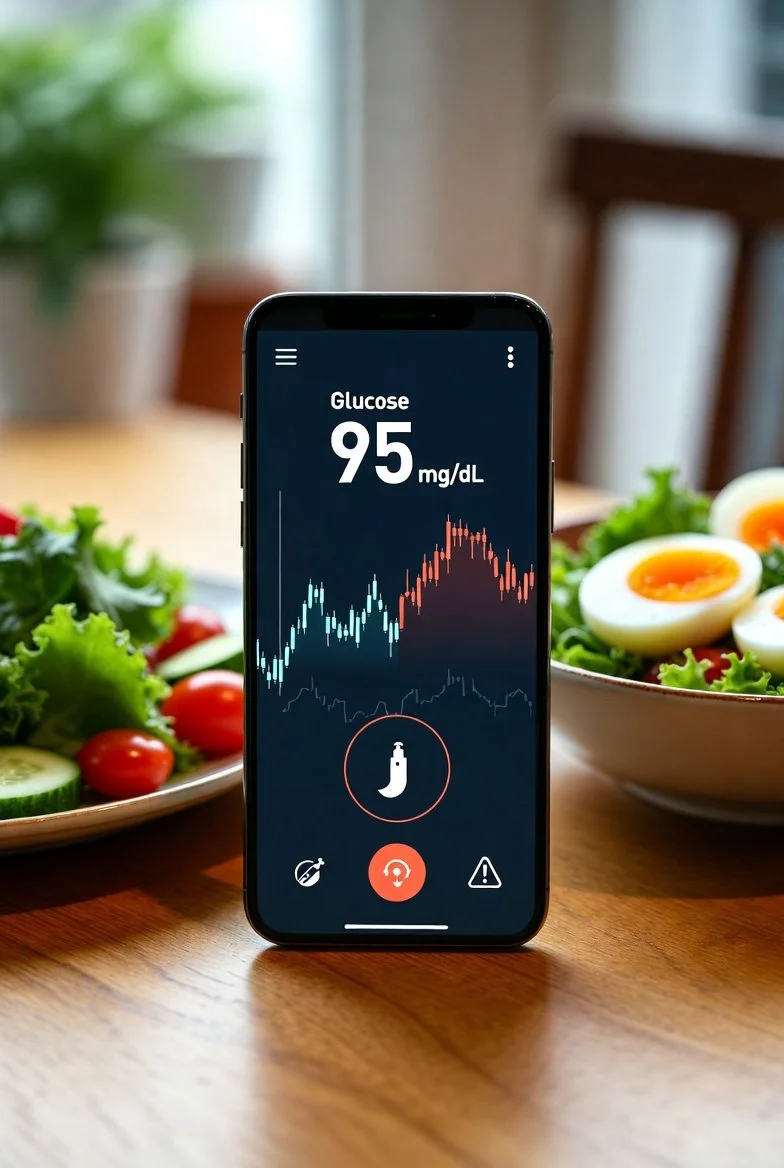
A Continuous Glucose Monitor is a small wearable sensor that tracks glucose levels 24 hours a day, typically every 5–15 minutes, for 10–14 days at a time.

Unlike a single fasting glucose or A1c, CGM shows:

  • How your glucose responds to real meals

  • What happens after exercise

  • The impact of sleep, stress, alcohol, and timing

  • Nighttime glucose patterns you never see on labs

In other words, it captures how your metabolism actually behaves in real life.

This makes CGM an awareness tool, not just a diagnostic one.

Why “Normal Labs” Can Still Miss Metabolic Risk

Many people come to us with:

  • Normal fasting glucose

  • “Acceptable” A1c

  • Good cholesterol numbers

  • A fit or lean appearance

And yet, when we place a CGM, we see:

  • Large glucose spikes after common meals

  • Prolonged elevations after eating

  • Poor overnight glucose stability

  • Stress-related glucose surges

  • Late-night eating that disrupts metabolic recovery

None of this shows up on a single lab draw.

You can look healthy and still be metabolically strained.

The Metabolically Invisible: A Special Consideration for women and Gay Men

This matters especially in populations where appearance, fitness, or leanness is often over-valued as a proxy for health — especially many women and gay men.

In our clinical experience, it is not uncommon to see:

  • Lean or muscular men with significant glucose variability

  • Highly active individuals compensating for poor metabolic recovery

  • Chronic stress, sleep disruption, or alcohol use masking metabolic strain

  • Body composition that looks “fit” while internal signaling is not resilient

There is also a cultural factor: many women and gay men have learned to optimize appearance before health, sometimes unconsciously.

CGM can gently but clearly show when the internal physiology does not match the external image — without shame, blame, or diagnosis.

It simply answers the question:

“How is my body actually handling energy?”

What CGM Teaches That Nothing Else Does

A CGM doesn’t tell you what to eat — it shows you how your body responds.

Common insights include:

  • Two people eating the same meal can have wildly different glucose responses

  • “Healthy” foods may spike one person and stabilize another

  • Protein timing can dramatically blunt glucose spikes

  • Walking after meals often matters more than what you ate

  • Late-night eating can impair overnight metabolic recovery

  • Poor sleep raises glucose even without food

This moves nutrition from ideology to personal physiology.

CGM Is Not About Perfection — It’s About Awareness

At Torre Prime, we do not use CGM to chase flat lines or create food anxiety.

We use it to:

  • Identify early metabolic stress

  • Improve energy and focus

  • Guide smarter meal timing

  • Support training and recovery

  • Reduce long-term cardiometabolic risk

  • Build metabolic flexibility, not rigidity

CGM is a short-term window that creates long-term insight.

Most people only need it once or twice to fundamentally change how they understand their body.

How CGM Fits Into the Torre Prime Model

At Torre Prime, CGM is primarily a Forge-phase tool.

While basic glucose labs help with awareness, CGM goes a step further — it shows how your metabolism performs in real time, under real-world conditions.

That places it squarely in The Forge: Metabolic Strength & Cellular Energy.

  • Forge:
    Build metabolic resilience by understanding glucose dynamics, insulin signaling, meal timing, recovery, and energy utilization — then using that data to improve flexibility, stability, and long-term performance.

CGM helps answer questions like:

  • How efficiently do you clear glucose?

  • How resilient is your metabolism under stress?

  • Are you fueling in a way that supports training, recovery, and energy?

  • Is your body flexible — or fragile — when conditions change?

For many patients, CGM is the moment metabolism stops being theoretical and becomes trainable.

“I finally understand how my body handles energy — and what to do about it.”

The Takeaway

You don’t need to be diabetic to benefit from glucose awareness.
You don’t need abnormal labs to have metabolic strain.
And you don’t need to look “unhealthy” to deserve deeper insight.

CGM helps close the gap between how you look and how you function.

And for many people — especially those who’ve been told they’re “fine” — it becomes the most clarifying tool they’ve ever used.

Want to Explore CGM as Part of Your Longevity Strategy?

CGM is available as part of Torre Prime’s Forge evaluation, with guided interpretation and practical coaching — not raw data dumps.

Awareness first. Alignment next.

Start Strong. Rise Higher.

Read More

The Ultimate Guide to Longevity Medicine in 2026

What Longevity Medicine Actually Is, Why It’s Different, and How to Do It Right

Longevity medicine has officially crossed a threshold.

In 2026, it’s no longer fringe, futuristic, or reserved for Silicon Valley biohackers. It’s becoming a legitimate, evidence-informed medical discipline—one that asks a radically different question than traditional healthcare:

Not “How do we treat disease?” but “How do we preserve function, vitality, and meaning for decades to come?”

This guide explains what longevity medicine really is, how it differs from conventional care and anti-aging marketing, what actually matters in 2026, and how to know whether you’re doing it—or just buying expensive noise.

What Longevity Medicine Actually Is, Why It’s Different, and How to Do It Right

Longevity medicine has officially crossed a threshold.

In 2026, it’s no longer fringe, futuristic, or reserved for Silicon Valley biohackers. It’s becoming a legitimate, evidence-informed medical discipline—one that asks a radically different question than traditional healthcare:

Not “How do we treat disease?” but “How do we preserve function, vitality, and meaning for decades to come?”

This guide explains what longevity medicine really is, how it differs from conventional care and anti-aging marketing, what actually matters in 2026, and how to know whether you’re doing it—or just buying expensive noise.

What Is Longevity Medicine?

Longevity medicine is a preventive, proactive, data-driven approach to extending healthspan—the number of years you live with strength, cognition, independence, and vitality.

It focuses on:

  • Reducing risk before disease appears

  • Preserving physical, metabolic, cognitive, and sexual function

  • Aligning medical strategy with how you actually want to live

Unlike traditional medicine, it does not wait for:

  • A heart attack

  • A diabetes diagnosis

  • A cancer staging report

  • Cognitive decline that’s already underway

And unlike anti-aging marketing, it’s not about:

  • “Reversing aging”

  • Cosmetic fixes

  • Supplement stacks without strategy

Longevity medicine is structured prevention, not wishful thinking.

Medicine 2.0 vs Medicine 3.0 (Why This Shift Matters)

Most healthcare today still operates in what many call Medicine 2.0:

  • Reactive

  • Disease-based

  • Short visits

  • Fragmented specialists

  • Lab “normal ranges” that ignore long-term risk

Medicine 3.0, the foundation of modern longevity medicine, shifts the paradigm:

  • Proactive and preventive

  • Risk-stratified and personalized

  • Focused on trajectories, not snapshots

  • Built around function, not just survival

In 2026, this distinction matters more than ever—because people are living longer, but not better.

The Core Pillars of Longevity Medicine in 2026

Longevity medicine has matured. The signal has separated from the noise. In 2026, effective programs consistently address eight interconnected domains:

1. Cardiovascular Risk — The Silent Driver

Heart disease remains the #1 cause of death, and risk often begins decades before symptoms.

Modern longevity care looks beyond cholesterol alone and evaluates:

  • ApoB and particle burden

  • Lipoprotein(a)

  • Blood pressure patterns

  • Inflammation markers

  • Imaging (CAC, CT angiography when appropriate)

Waiting for symptoms is no longer acceptable.

2. Metabolic Health — The Root System

Insulin resistance, visceral fat, and poor metabolic flexibility quietly fuel:

  • Heart disease

  • Cancer risk

  • Cognitive decline

  • Low energy and fatigue

Longevity medicine prioritizes:

  • Body composition over weight alone

  • Glucose regulation

  • Protein adequacy

  • Muscle preservation

Metabolic health is not cosmetic—it’s foundational.

3. Strength, Muscle, and Physical Capacity

After age 40, muscle loss accelerates unless actively resisted.

In 2026, longevity medicine treats strength like a vital sign:

  • Resistance training

  • Stability and balance

  • VO₂ max and aerobic capacity

  • Mobility and joint integrity

If you can’t lift, carry, balance, and recover, longevity becomes theoretical.

4. Cognitive Health — Before Symptoms

Dementia prevention does not begin with memory loss.

Longevity care assesses:

  • Sleep quality

  • Hearing

  • Vascular health

  • Mood and stress

  • Cognitive load and recovery

The goal is preserving clarity, not reacting to decline.

5. Sleep and Circadian Health

Sleep is no longer considered “lifestyle”—it’s medical infrastructure.

Longevity medicine evaluates:

  • Sleep duration and efficiency

  • Circadian alignment

  • Sleep-disrupting medications

  • Hormonal and stress contributors

You cannot out-supplement poor sleep.

6. Sexual Health and Vitality

Libido, erectile function, and sexual energy are early warning signals, not indulgences.

In 2026, longevity medicine recognizes sexual health as:

  • A cardiovascular marker

  • A hormonal signal

  • A quality-of-life pillar

  • A motivator for engagement and behavior change

Vitality matters.

7. Emotional Health and Stress Physiology

Chronic stress silently erodes:

  • Sleep

  • Metabolism

  • Blood pressure

  • Immune function

  • Relationships

Longevity medicine integrates:

  • Nervous system regulation

  • Emotional resilience

  • Recovery capacity

Not as therapy replacement—but as medical reality.

8. Purpose and Alignment

Longevity without meaning fails.

In 2026, the best programs acknowledge that:

  • Purpose affects physiology

  • Identity shapes behavior

  • Disconnection accelerates decline

Longevity is not just adding years—it’s ensuring you want to live them.

What Longevity Medicine Is Not

Clarity matters.

Longevity medicine is not:

  • A supplement subscription

  • A hormone mill

  • A cosmetic clinic with labs

  • A one-time “executive physical”

  • A guarantee of outcomes

Any program promising certainty should raise concern.

Longevity medicine manages risk, probability, and trajectory—not destiny.

How Torre Prime Approaches Longevity Medicine

At Torre Prime, longevity is structured into clear phases, not vague promises:

  • The Sentinel — Awareness & Risk Mapping

  • The Compass — Turning data into direction

  • The Forge — Metabolic and cellular resilience

  • The Temple — Strength, VO₂ max, stability, and performance

  • The Lighthouse — Cognitive, stress, and sleep alignment

  • The Flame — Vitality, intimacy, and hormonal health

  • The Horizon — Purpose and internal architecture

  • The Summit — Integration and yearly recalibration

Each phase builds on the last. No shortcuts. No overwhelm.

And full transparency:

At Torre Prime, we believe in 100% transparency of medical care and patient ownership of your own health. The documents we provide you are the same documents and reports going into your files, and you have access to them anytime you choose — because it's your health, and they're your records.

Who Longevity Medicine Is For (and Who It Isn’t)

Longevity medicine is ideal if you:

  • Are healthy but want to stay that way

  • Feel “off” despite normal labs

  • Want to be strong, clear, and capable decades from now

  • Prefer prevention over reaction

  • Value data and meaning

It may not be right if you:

  • Want quick cosmetic fixes only

  • Prefer minimal involvement

  • Aren’t ready to engage with your own health

Longevity is participatory.

The Bottom Line for 2026

Longevity medicine is no longer about living forever.

It’s about:

  • Fewer medical surprises

  • More physical capability

  • Clearer thinking

  • Sustained vitality

  • A body that supports the life you want to live

Done correctly, it’s not extreme—it’s intentional.

Ready to Begin?

If you want to understand your personal risk map and where to intervene first, the starting point is The Sentinel.

Start with awareness. Then build forward.

Read More

Why Most Doctors Don’t Have a Longevity Plan — And Why That Means Risk for You

The uncomfortable truth: most doctors do not practice longevity medicine.

If you’ve ever wondered why your annual physical feels brief, reactive, or disconnected from your long-term goals, there’s a reason.
Most doctors don’t have a structured longevity plan for themselves — and therefore can’t build one for you.

This isn’t about intelligence. It isn’t about caring. Physicians care deeply.
It’s about the system they’re trained in.

And the consequences for patients are real: delayed diagnoses, missed risk signals, preventable disease, fragmented guidance, and the quiet erosion of healthspan.

Let’s break down why this happens — and how choosing a practice built on a true longevity framework radically changes your outcomes. - Gabriel Felsen MD

The uncomfortable truth: most doctors do not practice longevity medicine.

If you’ve ever wondered why your annual physical feels brief, reactive, or disconnected from your long-term goals, there’s a reason.
Most doctors don’t have a structured longevity plan for themselves — and therefore can’t build one for you.

This isn’t about intelligence. It isn’t about caring. Physicians care deeply.
It’s about the system they’re trained in.

And the consequences for patients are real: delayed diagnoses, missed risk signals, preventable disease, fragmented guidance, and the quiet erosion of healthspan.

Let’s break down why this happens — and how choosing a practice built on a true longevity framework radically changes your outcomes.

Physicians are trained in crisis medicine, not prevention.

Medical school is extraordinary at teaching how to diagnose a heart attack.
It is not designed to teach how to avoid one 20 years before it happens.

The system rewards:

  • Treating disease, not preventing it

  • Speed, not depth

  • Reimbursement codes, not root-cause analysis

  • “Normal range” thinking, not optimal thinking

A typical primary care visit simply isn’t built for advanced risk prevention.
Longevity medicine is.

Attia’s Outlive describes this well — crisis medicine saves lives, but it was never meant to build healthspan. That requires a different skillset, different tools, and a different framework.

Most doctors don’t have time for their own health, let alone a personalized plan.

Doctors are some of the most overworked professionals in the world. Burnout rates are at historic highs. And when a physician’s schedule allows almost no time for their own structured health plan, they cannot authentically guide one for someone else.

A longevity plan requires:

  • Baseline diagnostics

  • Deep metabolic assessment

  • Cognitive risk mapping

  • Fitness and mobility testing

  • Sleep analysis

  • Nutrition strategy aligned with biochemistry

  • Follow-through

Traditional training simply doesn’t provide the infrastructure for this.

At Torre Prime, we built that infrastructure first — then built the patient experience on top of it.

Medical culture often accepts decline as “normal.”

This is one of the most damaging assumptions in modern healthcare.

Fatigue? “Getting older.”
Weight gain? “Slowing metabolism.”
Brain fog? “Stress probably.”
Low libido? “Happens with age.”
ApoB of 130? “Probably fine.”

None of this is actually normal — it’s just common.

Longevity medicine rejects the idea that decline is inevitable. It asks:

How do we create the best possible health, performance, and clarity for the longest possible time?

This is where mitochondrial health, muscle-centric longevity, and nervous system and sleep regulation integrate into one consistent system.

Doctors rarely get trained in metabolic health, strength training, or VO₂max optimization.

Your lifespan is closely linked to your muscle mass, functional strength, metabolic flexibility, and cardiovascular capacity — the “centenarian decathlon” principles.

Most physicians do not receive training in:

  • Strength periodization

  • Zone 2 conditioning

  • VO₂max development

  • HRV and autonomic balance

  • DNS-style stability and mobility

  • Sarcopenia prevention

  • Nutrition for mitochondrial efficiency

These are not fringe strategies — they are survival strategies.
And they are not covered in traditional medical education.

This leaves patients with vague advice like “exercise more” instead of the precision needed to bend the aging curve.

The medical system is not built to keep you well — it’s built to keep you alive.

These are very different goals.

Traditional care focuses on:

  • Managing blood pressure

  • Preventing hospitalizations

  • Controlling symptoms

Longevity care focuses on:

  • Adding decades of high-quality living

  • Preventing the Four Horsemen of chronic disease

  • Expanding cognitive, physical, and emotional capacity

  • Personalizing strategies to your genetics, labs, sleep, metabolism, and lifestyle

  • Building a healthier baseline every year

If traditional medicine is the fire department, longevity medicine is architecture — designing the structure so the fire never starts.

When your doctor doesn’t have a longevity plan, you end up reacting instead of leading.

Without a roadmap, you get:

  • Annual physicals that feel generic

  • “Normal” labs that miss early disease signals

  • Unclear advice about diet, supplements, and exercise

  • No strategy for metabolic health or cognitive aging

  • Fragmented recommendations from specialists who don’t talk to each other

  • The creeping feeling that something’s “off,” but no one is connecting the dots

A longevity plan eliminates all of this.

At Torre Prime, every patient receives:

  • Sentinel: advanced risk mapping

  • Compass: personalized 90-day execution plan

  • Forge: metabolic optimization

  • Temple: strength, VO₂max, and mobility

  • A single physician who knows every layer of your data, story, and goals

This is not concierge medicine.
This is structured, evidence-based healthspan engineering.

So why does this gap matter for you?

Because most age-related disease starts quietly, slowly, and decades before symptoms.
Without a longevity plan, you’re navigating blind.

A structured longevity framework means:

  • You understand your risk long before it becomes disease

  • You train your body for the next decade, not the last one

  • You protect your brain and cognitive future

  • You build metabolic resilience instead of waiting for a diagnosis

  • You sleep better, recover better, and age slower

  • You gain clarity, purpose, and direction

Longevity is not a trend — it is the evolution of modern medicine.
And it only works when it is intentional.

The takeaway

Most doctors don’t have a longevity plan because the system wasn’t designed to create one.

But your life is long enough, valuable enough, and meaningful enough to deserve more than “reactive healthcare.”

You deserve a roadmap — tailored, precise, and built for the long game.

If you’re ready to know where you stand and what to do next, start with The Sentinel.
It’s the foundation of every transformation we create at Torre Prime.

Read More