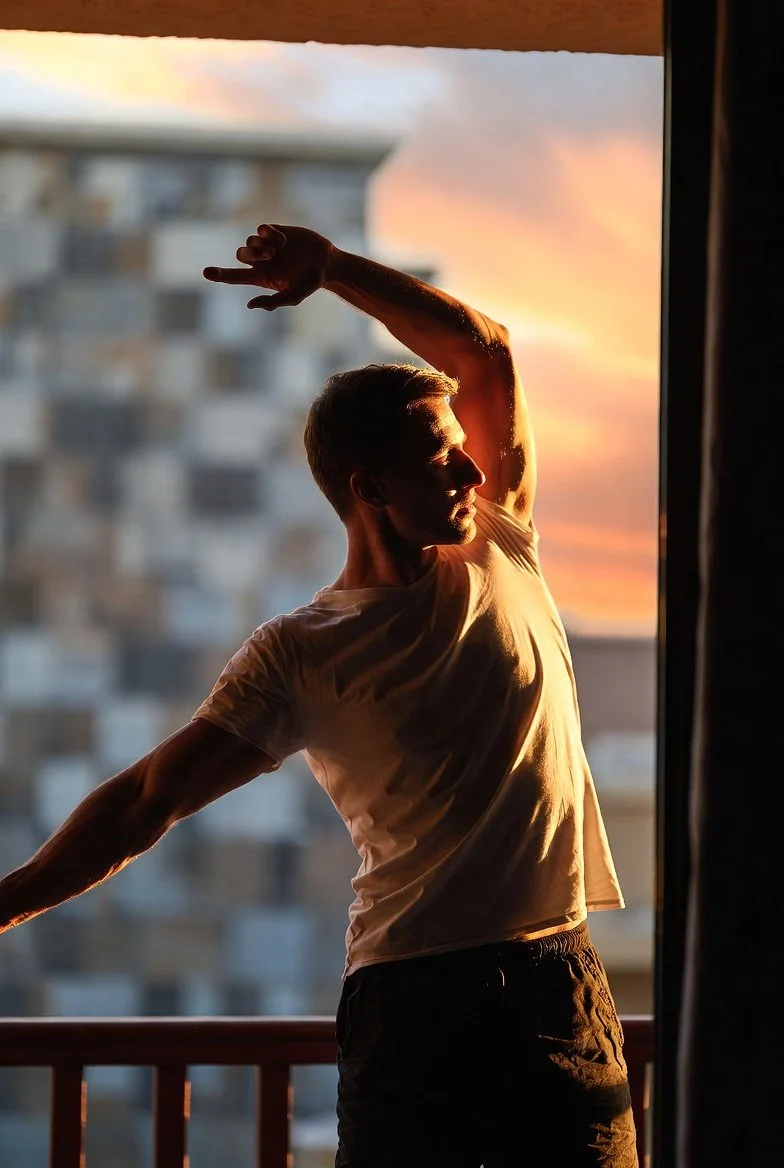
Travel, Rest, Move: The Longevity Approach to Physical Activity on Vacation
Working Out & Staying Physically Active on Vacation
How to protect your body, energy, and momentum—without turning your trip into a boot camp
Vacation is meant to restore you, not derail you. At Torre Prime, we don’t view physical activity on vacation as a “discipline test.” We see it as maintenance of momentum—protecting strength, mobility, metabolic health, and nervous system regulation while you’re away from your normal routine.
You don’t need long workouts, perfect programming, or a gym membership. You need movement with intention.

How to protect your body, energy, and momentum—without turning your trip into a boot camp
Vacation is meant to restore you, not derail you. At Torre Prime, we don’t view physical activity on vacation as a “discipline test.” We see it as maintenance of momentum—protecting strength, mobility, metabolic health, and nervous system regulation while you’re away from your normal routine.
You don’t need long workouts, perfect programming, or a gym membership. You need movement with intention.
Why Movement on Vacation Matters
When you stop moving entirely, even for a week, the body adapts quickly—often in the wrong direction.
On vacation, complete inactivity can contribute to:
Increased stiffness and joint pain
Loss of strength and muscle activation
Worsened blood sugar control
Poor sleep quality
Lower mood and mental clarity
Staying active—even lightly—helps preserve:
Muscle tone and neuromuscular coordination
Metabolic flexibility
Circulation and lymphatic flow
Stress regulation and sleep rhythm
This isn’t about “burning calories.” It’s about keeping the system online.
Reframing the Goal: Move, Don’t “Train”
Vacation workouts are not the time to chase PRs or punish yourself for enjoying food and rest.
Instead, aim for:
Short sessions
Full-body movements
Low friction (easy to start, easy to finish)
Activities that enhance the trip rather than compete with it
Think of movement as supporting your vacation, not stealing time from it.
The Vacation Movement Hierarchy
If you do nothing else, prioritize movement in this order:
Walking comes first
Walking is the most underrated vacation exercise. Exploring cities, beaches, trails, or neighborhoods on foot:
Supports cardiovascular health
Improves insulin sensitivity
Enhances digestion
Reduces stress
Aim for daily walking without obsessing over distance.
Mobility and joint care
Travel tightens hips, backs, calves, and shoulders. Five to ten minutes of gentle mobility in the morning or evening can:
Reduce soreness
Improve posture
Prevent next-day stiffness
Brief strength activation
Two to three short sessions during the week help maintain strength signals to the body:
Bodyweight squats or lunges
Push-ups (or incline push-ups)
Rows using bands or luggage
Planks or carries
Ten to twenty minutes is enough.
A Simple No-Equipment Vacation Routine
Use this anywhere—hotel room, beach, balcony, or park.
Do 2–4 rounds at a relaxed pace:
Squats or split squats
Push-ups or wall push-ups
Hip hinges (good mornings or glute bridges)
Plank or dead bug
Slow nasal breathing between rounds
You should finish feeling energized, not depleted.
Built-In Vacation Workouts (That Don’t Feel Like Work)
Some of the best vacation movement doesn’t look like exercise at all:
Swimming in the ocean or pool
Hiking or nature walks
Paddleboarding or kayaking
Biking to explore a new area
Playing with kids or walking markets
If you’re breathing a little harder and smiling, it counts.
What About Gyms?
If your hotel has a gym and you enjoy it—great. If not, skip the stress.
Vacation fitness should:
Reduce friction
Increase enjoyment
Fit your environment
Forcing a gym routine that feels inconvenient often leads to skipping movement entirely.
Recovery Still Counts
Vacation is also a recovery opportunity. Support that with:
Sleep without alarms when possible
Sunlight exposure early in the day
Hydration (especially with heat, alcohol, or flying)
Light stretching before bed
Recovery plus light movement is often more beneficial than hard training with poor sleep.
The Torre Prime Perspective
Longevity isn’t built on perfect weeks—it’s built on consistency across imperfect ones.
Movement on vacation:
Preserves physical capacity
Protects metabolic health
Keeps your nervous system regulated
Makes returning to normal training easier
When you return home, you should feel ready to resume, not like you’re starting over.
Bottom Line
You don’t need to “stay on track” while traveling.
You just need to stay connected to your body.
Move daily. Move simply. Move in ways that enhance the experience of being alive in a new place.
That’s longevity in the real world.
Why Purpose Drift Happens to High Performers — And How to Get Back on Track
Purpose drift happens when high performers stay in motion but lose direction. Learn why it occurs, how it affects physiology, and how to realign your biology, identity, and routine for better energy, clarity, and longevity. Torre Prime explains how to get back on track. - Gabriel Felsen MD
When your outer success no longer matches your inner direction, the body notices.
High performers rarely fall apart dramatically.
They drift — slowly, silently, and often while everything on the outside looks perfectly fine.
If you’ve ever felt like you’re checking boxes instead of living a life, or moving fast without moving forward, you’re not broken.
You’re experiencing something profoundly human:
Purpose drift.
It’s what happens when your identity outruns your alignment, your routine no longer matches your values, or the life you built no longer reflects the person you’re becoming.
And in longevity medicine, purpose drift is not a philosophical issue — it’s a physiological one.
What Is Purpose Drift?
Purpose drift is the gradual widening of the gap between:
the life you are living, and
the life you feel meant to live.
It doesn’t show up as a crisis.
It shows up as:
muted motivation
subtle irritability
loss of direction
blaming yourself for “not trying hard enough”
feeling busy but unsatisfied
excelling at things that no longer feel meaningful
High performers don’t burn out by failing.
They burn out by succeeding at the wrong things for too long.
Why High Performers Are Especially Vulnerable
1. You’re trained to override signals
High performers are exceptional at pushing through discomfort — deadlines, stress, fatigue, doubt.
But over time, that skill can turn into a trap.
Your nervous system whispers long before it screams.
When you ignore the whispers, the whispers get louder.
2. Your identity is built on capability
You’re used to being the one who figures it out.
So when something feels off, you assume the problem is effort rather than direction.
You double down instead of reevaluating.
3. Your life becomes optimized, not aligned
You build systems, habits, and routines that maximize output.
Meanwhile, your inner landscape changes.
Your biology wants meaning, novelty, and direction — not just efficiency.
4. You don’t slow down long enough to hear yourself
High performers fill space.
Meetings, workouts, obligations, relationships, distractions.
Purpose needs whitespace.
Without it, drift becomes inevitable.
How Purpose Drift Shows Up in the Body
Purpose isn’t only psychological — it’s somatic.
When alignment drops, physiology responds.
Cortisol becomes erratic
Your stress rhythm becomes irregular.
You wake up in the middle of the night, feel wired when you should feel calm, or crash in the afternoons.
Dopamine runs low
You start needing more stimulation — caffeine, novelty, dopamine-hits — to feel the same motivation you used to feel naturally.
HRV drops
Your recovery capacity shrinks, even when you “do everything right.”
Fatigue becomes emotional instead of physical
You’re tired, but not sleepy.
Rest doesn’t feel like restoration.
Mood flattens
Not depressed.
Not anxious.
Just… muted.
This is what we see constantly in the Sentinel and Lighthouse phases at Torre Prime — physiology mirroring psychology, and vice versa.
Why Purpose is a Longevity Variable
People think longevity is about:
cholesterol
glucose
VO2 max
inflammation
And it is.
But purpose is one of the strongest behavioral predictors of long-term healthspan.
Without direction, consistency collapses:
nutrition drifts
sleep becomes irregular
movement feels optional
stress becomes background noise
relationships become transactional
Purpose is the internal alignment that makes all the external behaviors possible.
When your “why” weakens, every “how” frays.
How to Get Back on Track: The Torre Prime Approach
1. Slow down enough to hear the signals
Before optimization comes listening.
Most high performers don’t lack discipline — they lack clarity.
Questions to ask yourself:
“What part of my life feels heavy?”
“Where am I acting out of obligation, not alignment?”
“What energizes me that I’ve been ignoring?”
Awareness is the first lever of the Compass phase.
2. Re-anchor your physiology
If your biology is off, your sense of direction will always feel distorted.
Start with the fundamentals:
consistent wake time
morning light
daily movement
structured meals
controlled stimulants
space for reflection
Purpose cannot land in a dysregulated nervous system.
3. Identify the misalignment, not the failure
Drift isn’t a character flaw — it’s a signal.
Where your life feels “off” is not where you’re failing.
It’s where you’re evolving.
Purpose recalibration begins where friction accumulates.
4. Rebuild rhythm around the identity you’re becoming
Most people try to change their life by changing their actions.
At Torre Prime, we flip that:
Identity first.
Behavior second.
Systems third.
You are not trying to return to an old version of yourself.
You are building the architecture for the next version.
5. Move from achievement to alignment
High performers can achieve almost anything.
Alignment is choosing the right things to achieve.
When your biology, behavior, and identity line up — momentum follows.
Energy returns.
Direction becomes intuitive.
Purpose feels embodied instead of aspirational.
The Bottom Line
Purpose drift isn’t a crisis.
It’s a recalibration.
It’s your internal compass telling you that your life, your identity, and your biology are ready to evolve.
High performers don’t lose their purpose — they outgrow it.
When you understand that drift is a signal, not a failure, you get to participate in the next chapter instead of fighting the last one.
At Torre Prime, this is the deeper work beneath longevity — the shift from surviving your life to shaping it.