Gabriel Felsen Gabriel Felsen

The Hidden Signal: Why Continuous Glucose Monitoring (CGM) Matters — Even If You “Look Healthy”

If you were taught that glucose problems only matter once someone is “diabetic,” you were taught Medicine 2.0.

In modern longevity medicine, glucose is not a diagnosis — it’s a signal. And like most important signals in the body, it often changes long before symptoms appear.

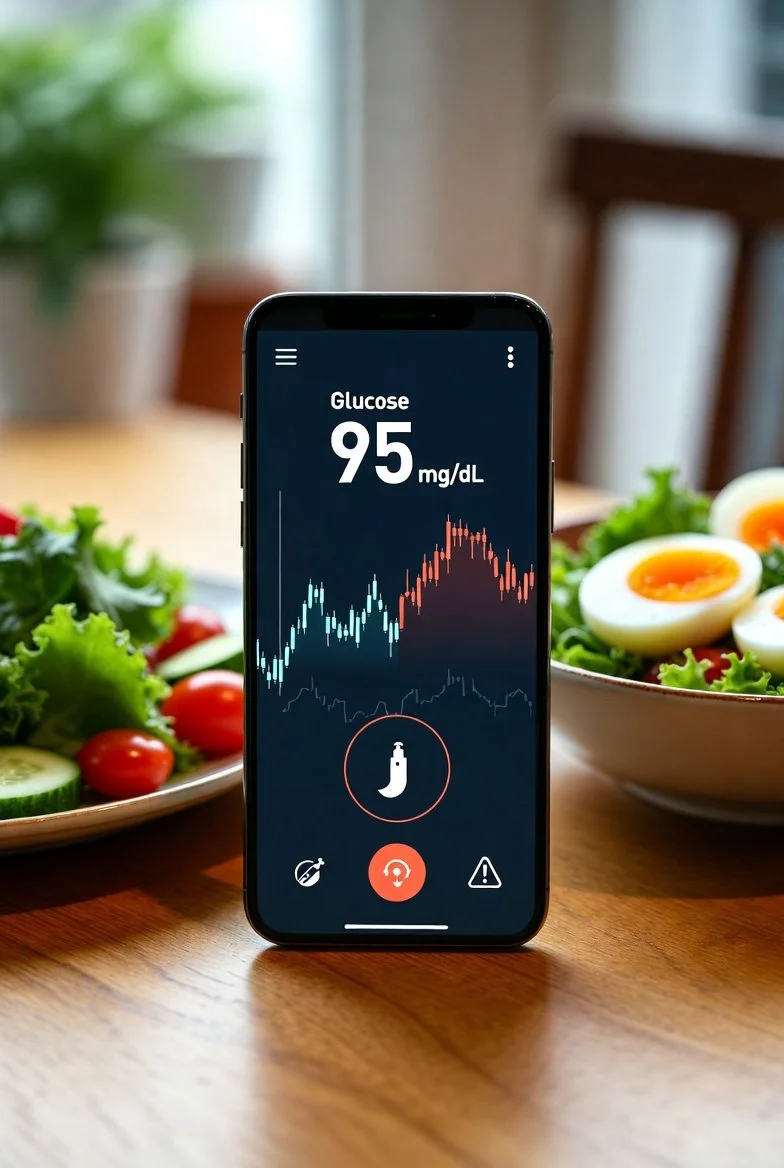
This is where Continuous Glucose Monitoring (CGM) becomes one of the most powerful awareness tools we have.

At Torre Prime, we use CGM not to label people — but to reveal patterns, identify early risk, and guide smarter decisions long before disease develops.

If you were taught that glucose problems only matter once someone is “diabetic,” you were taught Medicine 2.0.

In modern longevity medicine, glucose is not a diagnosis — it’s a signal. And like most important signals in the body, it often changes long before symptoms appear.

This is where Continuous Glucose Monitoring (CGM) becomes one of the most powerful awareness tools we have.

At Torre Prime, we use CGM not to label people — but to reveal patterns, identify early risk, and guide smarter decisions long before disease develops.

What Is a CGM — and Why It’s Different From a Blood Test

A Continuous Glucose Monitor is a small wearable sensor that tracks glucose levels 24 hours a day, typically every 5–15 minutes, for 10–14 days at a time.

Unlike a single fasting glucose or A1c, CGM shows:

  • How your glucose responds to real meals

  • What happens after exercise

  • The impact of sleep, stress, alcohol, and timing

  • Nighttime glucose patterns you never see on labs

In other words, it captures how your metabolism actually behaves in real life.

This makes CGM an awareness tool, not just a diagnostic one.

Why “Normal Labs” Can Still Miss Metabolic Risk

Many people come to us with:

  • Normal fasting glucose

  • “Acceptable” A1c

  • Good cholesterol numbers

  • A fit or lean appearance

And yet, when we place a CGM, we see:

  • Large glucose spikes after common meals

  • Prolonged elevations after eating

  • Poor overnight glucose stability

  • Stress-related glucose surges

  • Late-night eating that disrupts metabolic recovery

None of this shows up on a single lab draw.

You can look healthy and still be metabolically strained.

The Metabolically Invisible: A Special Consideration for women and Gay Men

This matters especially in populations where appearance, fitness, or leanness is often over-valued as a proxy for health — especially many women and gay men.

In our clinical experience, it is not uncommon to see:

  • Lean or muscular men with significant glucose variability

  • Highly active individuals compensating for poor metabolic recovery

  • Chronic stress, sleep disruption, or alcohol use masking metabolic strain

  • Body composition that looks “fit” while internal signaling is not resilient

There is also a cultural factor: many women and gay men have learned to optimize appearance before health, sometimes unconsciously.

CGM can gently but clearly show when the internal physiology does not match the external image — without shame, blame, or diagnosis.

It simply answers the question:

“How is my body actually handling energy?”

What CGM Teaches That Nothing Else Does

A CGM doesn’t tell you what to eat — it shows you how your body responds.

Common insights include:

  • Two people eating the same meal can have wildly different glucose responses

  • “Healthy” foods may spike one person and stabilize another

  • Protein timing can dramatically blunt glucose spikes

  • Walking after meals often matters more than what you ate

  • Late-night eating can impair overnight metabolic recovery

  • Poor sleep raises glucose even without food

This moves nutrition from ideology to personal physiology.

CGM Is Not About Perfection — It’s About Awareness

At Torre Prime, we do not use CGM to chase flat lines or create food anxiety.

We use it to:

  • Identify early metabolic stress

  • Improve energy and focus

  • Guide smarter meal timing

  • Support training and recovery

  • Reduce long-term cardiometabolic risk

  • Build metabolic flexibility, not rigidity

CGM is a short-term window that creates long-term insight.

Most people only need it once or twice to fundamentally change how they understand their body.

How CGM Fits Into the Torre Prime Model

At Torre Prime, CGM is primarily a Forge-phase tool.

While basic glucose labs help with awareness, CGM goes a step further — it shows how your metabolism performs in real time, under real-world conditions.

That places it squarely in The Forge: Metabolic Strength & Cellular Energy.

  • Forge:
    Build metabolic resilience by understanding glucose dynamics, insulin signaling, meal timing, recovery, and energy utilization — then using that data to improve flexibility, stability, and long-term performance.

CGM helps answer questions like:

  • How efficiently do you clear glucose?

  • How resilient is your metabolism under stress?

  • Are you fueling in a way that supports training, recovery, and energy?

  • Is your body flexible — or fragile — when conditions change?

For many patients, CGM is the moment metabolism stops being theoretical and becomes trainable.

“I finally understand how my body handles energy — and what to do about it.”

The Takeaway

You don’t need to be diabetic to benefit from glucose awareness.
You don’t need abnormal labs to have metabolic strain.
And you don’t need to look “unhealthy” to deserve deeper insight.

CGM helps close the gap between how you look and how you function.

And for many people — especially those who’ve been told they’re “fine” — it becomes the most clarifying tool they’ve ever used.

Want to Explore CGM as Part of Your Longevity Strategy?

CGM is available as part of Torre Prime’s Forge evaluation, with guided interpretation and practical coaching — not raw data dumps.

Awareness first. Alignment next.

Start Strong. Rise Higher.

Read More
Gabriel Felsen Gabriel Felsen

The Most Common Regrets Gay Men Have About Their Health in Their 50s

Many gay men reach their 50s wishing they had started caring for their metabolism, strength, sexual vitality, and emotional health sooner. In this article, Dr. Gabriel Felsen breaks down the most common regrets—and how modern longevity medicine can help you change your trajectory starting today.

When I meet gay men in their 50s—whether at my clinic, at community events, or in a telemedicine visit—there’s a pattern that appears so consistently it’s almost predictable.
A sense of “I wish I had started sooner.”

Not because they’ve done anything wrong, but because no one ever taught them how their body really works, what longevity actually means, or how gay men’s health differs from the general population.

Based on my clinical work, decades of lived community experience, longevity research, and many of the stories shared directly with me, here are the seven most common health regrets gay men express in their 50s—and more importantly, what you can do about them now.

1. “I wish I had taken my metabolism seriously earlier.”

Many gay men arrive in midlife feeling like their metabolism changed “overnight.”
It didn’t.
It was slowly drifting for decades.

The regret:
Not paying attention to abdominal fat, rising waist size, creeping blood sugar, or declining muscle mass until they suddenly mattered.

What this really reflects:

  • Untreated insulin resistance

  • Chronically elevated glucose swings

  • Loss of metabolic flexibility

  • Inconsistent protein intake

  • Lack of intentional strength training

What to do now:
A metabolic reset is absolutely possible in your 50s.
The tools are:

  • Continuous glucose monitoring (CGM)

  • Strength training 3–4 days/week

  • High-protein, low-sugar nutrition

  • Tracking waist circumference, not just weight

2. “I should have protected my brain earlier.”

Gay men disproportionately face chronic minority stress, sleep disruption, burnout, and cortisol dysregulation.

By the 50s, this shows up as:

  • Brain fog

  • Forgetfulness

  • Poor focus

  • Emotional reactivity

  • Decreased sleep quality

The regret:
Not treating the brain as a long-term investment.

The truth from modern longevity science:
Brain aging begins in our 40s.
APOE4 risk, sleep quality, metabolic health, and stress load all shape cognitive aging.

What to do now:

  • Prioritize sleep as a biological training zone

  • Reduce alcohol (and other things)

  • Train VO2 max, not just muscles

  • Optimize vitamin D, B12, Omega-3

  • Address loneliness and social isolation (huge for gay men)

3. “I wish I had kept my strength.”

By 50, most men have lost over 30% of their peak muscle mass unless they actively trained strength.

For gay men specifically:

  • Aesthetics often overshadow function in youth

  • Cardio is overemphasized

  • True strength training is often delayed until too late

The regret:
Not building the “muscle reserve” that determines how well you age after 60.

Medicine 3.0 reality:
Muscle is the most important organ of longevity.

What to do now:

  • Heavy strength training 2–3×/week

  • Grip, carry, squat, hinge, and pull

  • Track your centenarian decathlon movements

  • Protein target: 1g per lb of ideal body weight

4. “I wish I had protected my sexual vitality.”

Many gay men in their 50s tell me:
“I thought erectile changes were just part of aging.”

They’re not.

The regret:
Waiting until their 50s to address:

  • Erections

  • Testosterone changes

  • Performance anxiety

  • Dopamine-driven exhaustion

  • Porn desensitization

  • Partner misalignment

  • Shame-based avoidance of sexual healthcare

Gay sexual health is both physical and emotional.
Men often suffer silently, believing something is “wrong” with them.

What to do now:

  • Assess hormones (don’t guess)

  • Address metabolic health (huge for erections)

  • Manage performance anxiety and sleep

  • Consider Trimix, PDE5 inhibitors, or combination protocols

  • Treat sex as part of overall vitality—not a separate topic

5. “I wish I had addressed sleep decades ago.”

Gay men have higher rates of insomnia, inconsistent schedules, nightlife habits, and cortisol shifts related to chronic stress.

By your 50s, poor sleep accelerates:

  • Weight gain

  • Brain aging

  • Hypertension

  • Mood instability

  • Erectile dysfunction

The regret:
Not understanding that sleep is the most powerful longevity drug we have.

What to do now:

  • A consistent bedtime (10 PM is ideal)

  • Reduce blue light 2 hours before bed

  • Target 90 minutes of slow-wave sleep

  • Reduce alcohol and late-night eating

  • Prioritize parasympathetic recovery (Downstate)

6. “I wish I had gotten my screenings earlier.”

This one is huge.

Gay men often avoid—or are not guided toward—early screening for:

  • Colorectal cancer

  • Prostate cancer

  • Coronary calcium scores

  • ApoB and advanced lipid panels

  • Sleep apnea

  • Liver health

  • STI screening

  • HIV PrEP management

  • Bone density

The regret:
Assuming that “normal labs” mean optimal health.

What to do now:
Medicine 3.0 means testing early, testing deeply, and acting proactively—not reactively.

7. “I wish I hadn’t waited to build a support system.”

By age 50, many gay men discover an unexpected truth:

Longevity requires other people.

Yet:

  • Many lived portions of life in secrecy or shame

  • Many avoided forming deep community

  • Many lost friends to HIV

  • Many struggle with midlife dating or partnership

  • Many fear being alone as they age

The regret:
Not investing in emotional well-being and community sooner.

The truth:
Loneliness is as dangerous as smoking 15 cigarettes a day.

What to do now:

  • Rebuild chosen family

  • Create routine contact—weekly dinners, group chats, meet-ups

  • Practice vulnerability

  • Build friendships around shared health goals

  • Work with a longevity physician trained in mental and emotional health

Why These Regrets Matter—And Why They’re Not Fixed Destiny

Here’s the message I give every man who walks into Torre Prime:

Regret is information.
Not punishment.
Not fate.
Just information.

And when you use regret as data, not shame, you gain something incredibly rare in healthcare:

Control.

You can rewrite your 50s.
You can change your trajectory for your 60s.
And your 70s, 80s, and beyond can look radically different than your parents’ generation.

That’s the entire purpose of longevity medicine.

What Torre Prime Does for Gay Men in Their 40s and 50s

At Torre Prime, we treat gay men’s longevity as its own specialty.

Our framework includes:

  • Deep-dive metabolic testing

  • CGM-guided nutrition

  • Hormone and sexual vitality medicine

  • Sleep architecture optimization

  • The Centenarian Decathlon

  • Advanced labs (apoB, Lp(a), insulin, inflammatory markers)

  • Early cancer screening

  • Stress load analysis

  • Cognitive preservation

  • Emotional and relational health

  • Community-building strategies

Because gay men deserve health care that gets us—not just “tolerates” us.

You don’t have to wait until you’re 60 to start over.


You can start today.

Read More