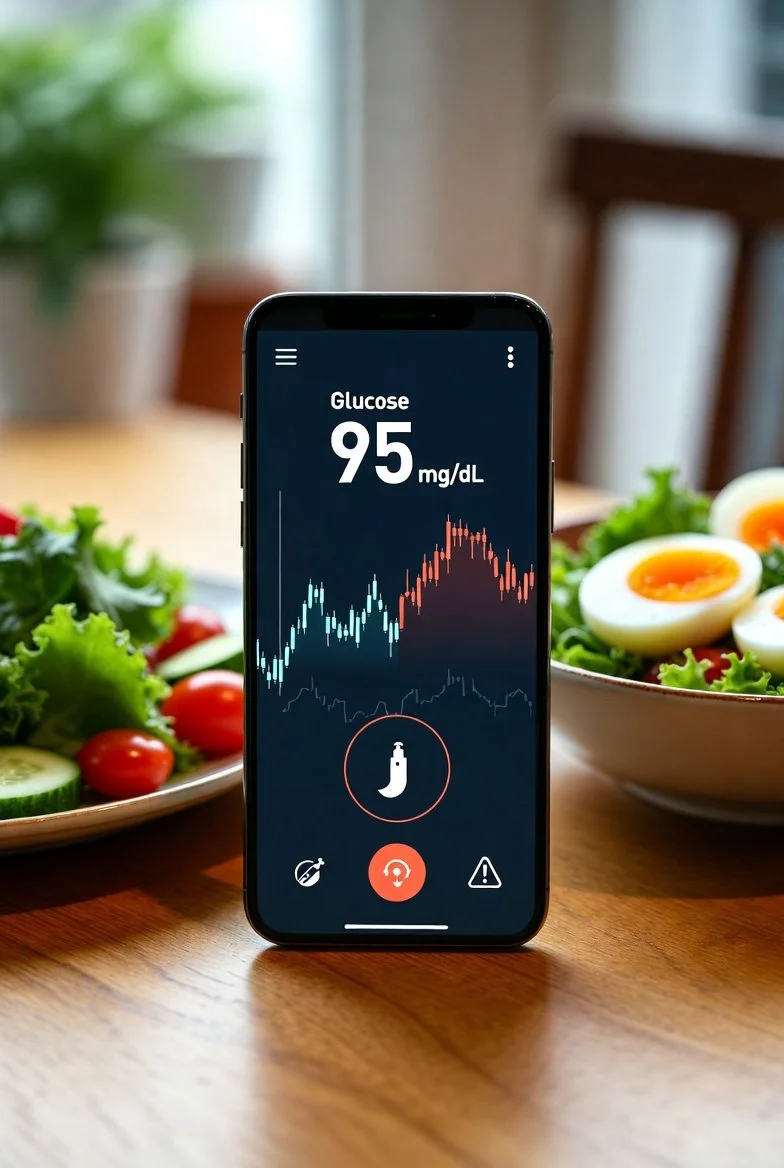
The Hidden Signal: Why Continuous Glucose Monitoring (CGM) Matters — Even If You “Look Healthy”
If you were taught that glucose problems only matter once someone is “diabetic,” you were taught Medicine 2.0.
In modern longevity medicine, glucose is not a diagnosis — it’s a signal. And like most important signals in the body, it often changes long before symptoms appear.
This is where Continuous Glucose Monitoring (CGM) becomes one of the most powerful awareness tools we have.
At Torre Prime, we use CGM not to label people — but to reveal patterns, identify early risk, and guide smarter decisions long before disease develops.
If you were taught that glucose problems only matter once someone is “diabetic,” you were taught Medicine 2.0.
In modern longevity medicine, glucose is not a diagnosis — it’s a signal. And like most important signals in the body, it often changes long before symptoms appear.
This is where Continuous Glucose Monitoring (CGM) becomes one of the most powerful awareness tools we have.
At Torre Prime, we use CGM not to label people — but to reveal patterns, identify early risk, and guide smarter decisions long before disease develops.
What Is a CGM — and Why It’s Different From a Blood Test
A Continuous Glucose Monitor is a small wearable sensor that tracks glucose levels 24 hours a day, typically every 5–15 minutes, for 10–14 days at a time.
Unlike a single fasting glucose or A1c, CGM shows:
How your glucose responds to real meals
What happens after exercise
The impact of sleep, stress, alcohol, and timing
Nighttime glucose patterns you never see on labs
In other words, it captures how your metabolism actually behaves in real life.
This makes CGM an awareness tool, not just a diagnostic one.
Why “Normal Labs” Can Still Miss Metabolic Risk
Many people come to us with:
Normal fasting glucose
“Acceptable” A1c
Good cholesterol numbers
A fit or lean appearance
And yet, when we place a CGM, we see:
Large glucose spikes after common meals
Prolonged elevations after eating
Poor overnight glucose stability
Stress-related glucose surges
Late-night eating that disrupts metabolic recovery
None of this shows up on a single lab draw.
You can look healthy and still be metabolically strained.
The Metabolically Invisible: A Special Consideration for women and Gay Men
This matters especially in populations where appearance, fitness, or leanness is often over-valued as a proxy for health — especially many women and gay men.
In our clinical experience, it is not uncommon to see:
Lean or muscular men with significant glucose variability
Highly active individuals compensating for poor metabolic recovery
Chronic stress, sleep disruption, or alcohol use masking metabolic strain
Body composition that looks “fit” while internal signaling is not resilient
There is also a cultural factor: many women and gay men have learned to optimize appearance before health, sometimes unconsciously.
CGM can gently but clearly show when the internal physiology does not match the external image — without shame, blame, or diagnosis.
It simply answers the question:
“How is my body actually handling energy?”
What CGM Teaches That Nothing Else Does
A CGM doesn’t tell you what to eat — it shows you how your body responds.
Common insights include:
Two people eating the same meal can have wildly different glucose responses
“Healthy” foods may spike one person and stabilize another
Protein timing can dramatically blunt glucose spikes
Walking after meals often matters more than what you ate
Late-night eating can impair overnight metabolic recovery
Poor sleep raises glucose even without food
This moves nutrition from ideology to personal physiology.
CGM Is Not About Perfection — It’s About Awareness
At Torre Prime, we do not use CGM to chase flat lines or create food anxiety.
We use it to:
Identify early metabolic stress
Improve energy and focus
Guide smarter meal timing
Support training and recovery
Reduce long-term cardiometabolic risk
Build metabolic flexibility, not rigidity
CGM is a short-term window that creates long-term insight.
Most people only need it once or twice to fundamentally change how they understand their body.
How CGM Fits Into the Torre Prime Model
At Torre Prime, CGM is primarily a Forge-phase tool.
While basic glucose labs help with awareness, CGM goes a step further — it shows how your metabolism performs in real time, under real-world conditions.
That places it squarely in The Forge: Metabolic Strength & Cellular Energy.
Forge:
Build metabolic resilience by understanding glucose dynamics, insulin signaling, meal timing, recovery, and energy utilization — then using that data to improve flexibility, stability, and long-term performance.
CGM helps answer questions like:
How efficiently do you clear glucose?
How resilient is your metabolism under stress?
Are you fueling in a way that supports training, recovery, and energy?
Is your body flexible — or fragile — when conditions change?
For many patients, CGM is the moment metabolism stops being theoretical and becomes trainable.
“I finally understand how my body handles energy — and what to do about it.”
The Takeaway
You don’t need to be diabetic to benefit from glucose awareness.
You don’t need abnormal labs to have metabolic strain.
And you don’t need to look “unhealthy” to deserve deeper insight.
CGM helps close the gap between how you look and how you function.
And for many people — especially those who’ve been told they’re “fine” — it becomes the most clarifying tool they’ve ever used.
Want to Explore CGM as Part of Your Longevity Strategy?
CGM is available as part of Torre Prime’s Forge evaluation, with guided interpretation and practical coaching — not raw data dumps.
Awareness first. Alignment next.
Start Strong. Rise Higher.